


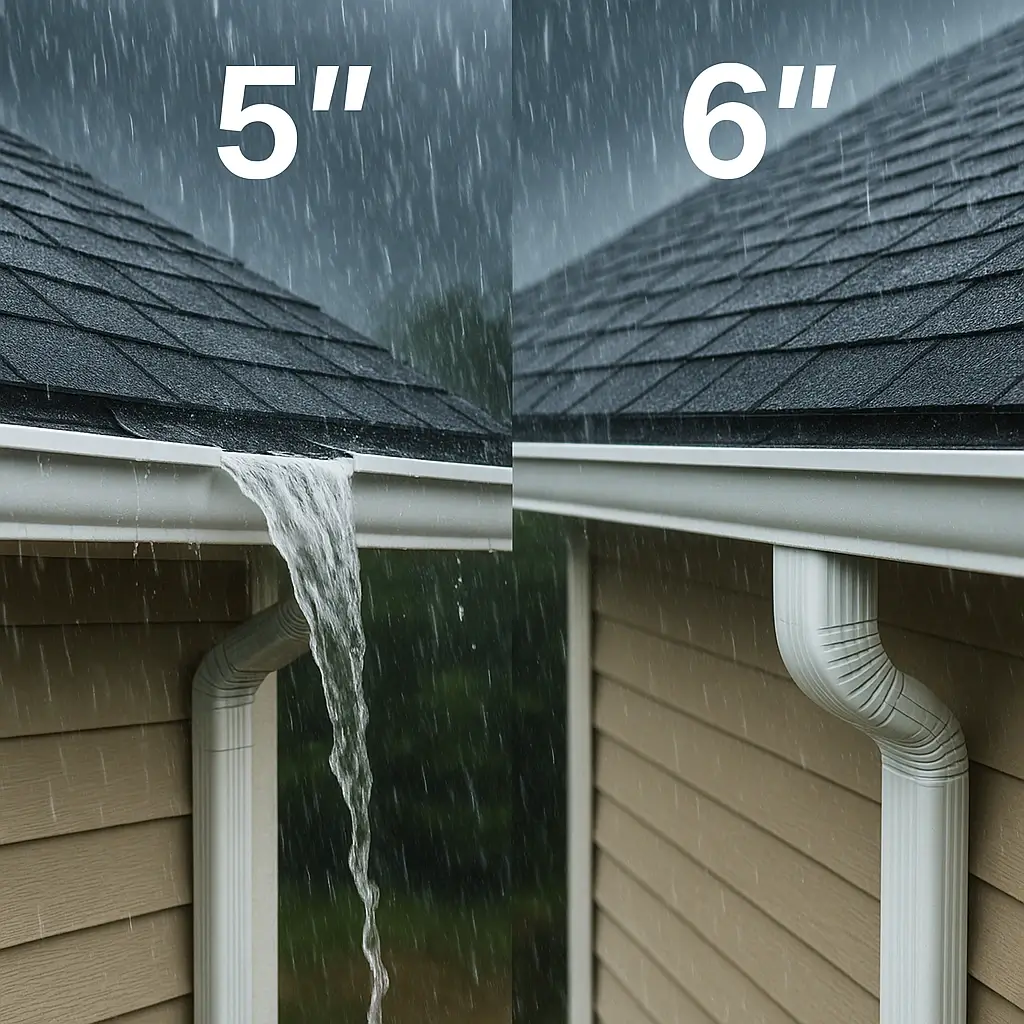
Heavy spring storms and sudden downpours are a fact of life in Oklahoma City and Tulsa. Whether you own a single-story home or manage a retail plaza, the right gutter size keeps that rainwater flowing away from walls and foundations. Below is a straightforward look at how 5-inch and 6-inch gutters compare and when each one earns its place on a roofline.
Capacity Counts
- Water volume: A 6-inch K-style gutter handles roughly 40 % more water than its 5-inch counterpart.
- Downspout match-up: Larger troughs pair with 3 × 4-inch downspouts, moving water faster and reducing clogs.
- Debris clearance: Extra width lets leaves and shingle grit flush through rather than forming stubborn dams.
When 5-Inch Gutters Work Fine
- Roof area under 1,600 sq ft with a moderate slope
- Single-story homes with short eave runs
- Sites surrounded by smaller ornamental trees
- Low-traffic outbuildings such as detached garages and garden sheds
These projects enjoy solid protection without the added material cost of the larger profile.
When 6-Inch Gutters Make Sense
- Roofs steeper than 6:12 or clad in metal, where water travels faster
- Long valleys that concentrate runoff into one point
- Two-story homes and commercial buildings with roof areas above 1,600 sq ft
- Locations beneath mature oaks, pecans, or sycamores that shed leaves and twigs all season
- Projects where underground drainage ties into the downspout and needs a steady flow to stay clear
Cost Factor
Upfront, 6-inch aluminum runs average 10–15 % more than 5-inch. The price difference comes from wider coil stock and larger downspouts. Balance that added material against the potential savings on fascia repairs, foundation sealing, and landscape washouts—especially if you own a property with high roof volume.
Oklahoma Weather Impact
| Scenario | 5-Inch Performance | 6-Inch Performance |
| Sudden 2-inch cloudburst | May overflow at long valleys | Carries flow cleanly |
| Wind-driven leaves in fall | Higher chance of dams | Extra width sheds debris faster |
| Hail up to 1 inch | Similar dent resistance (same metal gauge) | Similar dent resistance |
| Commercial flat roof draining to scuppers | Often undersized | Matches scupper output |
Downspout Pairing Tips
- Use at least one 3 × 4-inch downspout for every 40 linear feet of 6-inch gutter.
- Add a clean-out at ground level if the system ties into an underground drain line.
- Increase spout count on the rear of retail buildings where HVAC condensate lines already feed runoff.
How to Decide
- Measure the roof plane feeding each run (length × slope factor).
- Note roof pitch; steeper angles favor the larger profile.
- Count nearby trees that drop seasonal debris.
- Check local code for commercial buildings; many require 6-inch minimum on large surfaces.
- Factor resale: In competitive neighborhoods, larger gutters can be a quiet value add buyers appreciate during inspection.
Wrap-Up
Both 5-inch and 6-inch gutters earn their keep across Oklahoma. Homes with modest rooflines stay dry and tidy with 5-inch runs, while bigger residences, steep pitches, and most commercial properties benefit from the added capacity of 6-inch profiles. A quick assessment of roof size, pitch, and surrounding trees will point you to the best fit—and keep storm water where it belongs: moving safely away from your building. Or simply call Expert Gutters—we’ll recommend the right size for your home or commercial property, answer every question, and handle the installation from start to finish.